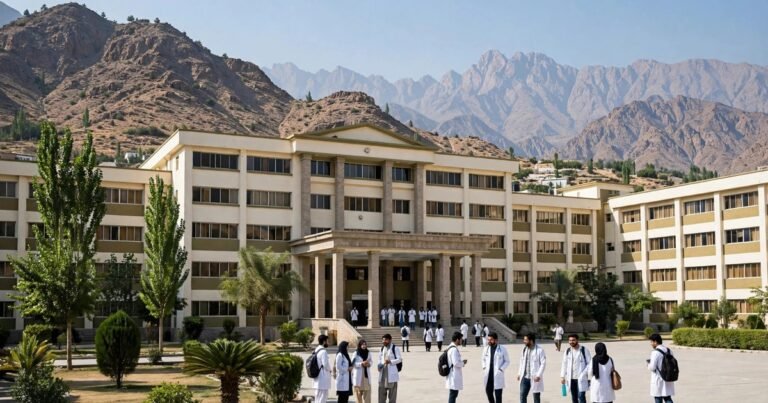
SZABMU MDCAT: Pattern, Eligibility and How to Prepare
Shaheed Zulfiqar Ali Bhutto Medical University, SZABMU, in Islamabad conducts its own MDCAT for admission to the public medical and dental colleges of the federal capital, including the colleges affiliated with the university. Students who want to study MBBS or BDS in Islamabad’s public sector colleges appear in this test, and the result carries a large share of the merit. This guide explains the SZABMU MDCAT pattern, who can apply, and how to prepare in a planned and steady way.
One point must be made clearly at the start. The SZABMU MDCAT syllabus, the test date, the registration fee and the passing marks are announced for each session by the university, and no date, fee or marks figure is stated in this guide. The test details can change from session to session, so always read the official announcement for your session before you begin preparation. Any date, fee or syllabus figure you see on social media or a random website should be treated as a rumour until the university confirms it.
Quick Facts
| Item | Detail |
|---|---|
| Test | SZABMU MDCAT |
| Conducted by | Shaheed Zulfiqar Ali Bhutto Medical University (SZABMU), Islamabad |
| Purpose | Entry test for MBBS and BDS admission in federal public medical and dental colleges |
| Subjects | Biology, Chemistry, Physics, English and Logical Reasoning |
| Based on | The intermediate (FSc pre-medical) syllabus |
| Official source | SZABMU’s official website and its published admission announcement |
| Dates, fees and passing marks | Announced for each session; no date, fee or marks figure is stated in this guide |
What the SZABMU MDCAT Is
Pakistan’s medical admissions are organised by region, and different bodies conduct the MDCAT for different areas. SZABMU conducts the test for the federal area, covering the public medical and dental colleges in Islamabad that fall under its umbrella. Students who apply to these colleges must appear in the SZABMU MDCAT, and their merit is worked out from their academic record and their test result.
The test itself follows the same general pattern as the national MDCAT. It is based on the FSc pre-medical syllabus, and it covers Biology, Chemistry, Physics, English and Logical Reasoning. Biology carries the largest share of the test, followed by Chemistry and Physics, with English and Logical Reasoning making up the remaining part. Because the test is based on the FSc books, preparation for the SZABMU MDCAT is the same in substance as preparation for any MDCAT; the difference is in the registration process, the test centre and the colleges you can apply to, so read the SZABMU announcement carefully for those details.
Who Can Apply
The basic requirement for MBBS and BDS through the SZABMU MDCAT is an FSc in the pre-medical stream, or an equivalent qualification recognised by the relevant authority. Students who have completed their intermediate education in pre-medical from a recognised board in Pakistan can normally apply. Students with an equivalent foreign qualification should check whether their certificate is accepted, and they may need an equivalence certificate from the Inter Board Committee of Chairmen, IBCC.
Only students who have appeared in the SZABMU MDCAT can be considered for admission to the federal public medical and dental colleges. The minimum marks required in FSc and in the MDCAT are fixed by the national medical regulatory body for each session, and the details are given in the official admission policy for that session.
Applicants should also check the domicile and seat rules for the federal colleges. The admission policy explains which seats are open to which students and what documents each category requires. If you are applying on a reserved seat, make sure you have the required certificate ready before you apply, because a missing certificate can delay or cancel your application.
Biology: The Largest Subject
Biology is the heart of the SZABMU MDCAT. It covers the main topics of first-year and second-year biology, including cell structure and function, biological molecules, enzymes, bioenergetics, human physiology, coordination and control, reproduction, inheritance, evolution and ecology. Human physiology is especially important, because it connects directly with the medicine you will study later.
To prepare biology well, read each chapter of your textbook slowly and understand it before moving on. Make short notes of the facts that are easy to forget, such as the names of structures, the steps of a process and the functions of organs. Revise these notes again and again, because biology in the MDCAT rewards memory as much as understanding. Our MDCAT biology preparation guide explains how to organise your biology revision chapter by chapter.
Diagrams deserve special attention. Many biology questions are based on diagrams in the textbook, so study every labelled diagram and learn what each part does. When you practise, cover the labels and try to name each part from memory. This simple exercise turns passive reading into active learning, and it makes the facts stay in your mind for much longer.
Chemistry: Concepts and Practice
Chemistry in the SZABMU MDCAT covers physical chemistry, organic chemistry and inorganic chemistry from the FSc syllabus. Physical chemistry includes topics such as chemical equilibrium, electrochemistry, chemical kinetics and thermochemistry. Organic chemistry covers the main families of compounds, their reactions and their uses. Inorganic chemistry includes the periodic table, chemical bonding and the chemistry of the elements.
Chemistry needs both understanding and practice. First, understand each concept clearly from your textbook. Then practise numerical problems until you can solve them quickly and without mistakes. Organic chemistry needs careful revision of reactions, so keep a separate notebook of reactions with their conditions and products, and revise it every week. Our MDCAT chemistry preparation guide explains how to divide your time between the three branches of chemistry.
Physics: Understanding and Numericals
Physics in the SZABMU MDCAT covers the main topics of first-year and second-year physics, including mechanics, waves, optics, electricity, magnetism and modern physics. The questions test your understanding of concepts and your ability to apply formulas to numerical problems. Physics is the subject that many medical students find hardest, because it needs both clear concepts and fast calculation.
To prepare physics well, start with the concept. Read the chapter, understand what each law means, and learn the formulas with their units. Then solve numerical problems from your textbook and from past papers. Keep a formula sheet and revise it daily, because a formula you cannot recall in the test is of no use. Our MDCAT physics preparation guide explains how to practise numericals in a planned way.
English and Logical Reasoning
English in the SZABMU MDCAT tests vocabulary, grammar and comprehension, including synonyms and antonyms, the correct use of words, sentence completion and short passages. English may carry a smaller share of the test than the science subjects, but it is often the subject that decides the difference between two close candidates. Logical Reasoning tests your ability to think clearly, with simple puzzles, series, analogies and short reasoning problems; it needs practice, not memorisation. Set aside a short time each day for both, and they will reward you with easy marks. Our MDCAT English preparation guide explains how to build vocabulary and grammar without wasting time.
How to Prepare for the SZABMU MDCAT: A Step-by-Step Plan
A good preparation plan is simple, steady and written down. Follow these steps:
- Read the official SZABMU announcement for your session and confirm the registration process, the test centres and the colleges covered.
- Download the official MDCAT syllabus for your session and read it fully. Mark the chapters of each subject that are included.
- Collect your FSc textbooks, your notes and a set of past papers. These are your main study materials.
- Make a weekly timetable that gives the most time to Biology, then Chemistry and Physics, with regular slots for English and Logical Reasoning.
- Study one subject at a time in the morning when your mind is fresh, and revise the same topic in the evening.
- After finishing each chapter, solve its questions from past papers and note the topics where you make mistakes.
- Keep a mistake notebook. Write down every question you got wrong and the correct answer, and revise this notebook every week.
- In the last weeks before the test, take full-length practice tests under timed conditions. Sit for the full time without a break, and mark yourself honestly.
- Revise your short notes and your formula sheet in the final days. Do not start any new topic at the last moment.
Our entry test preparation plan explains how to build a daily timetable and how to balance revision with practice tests. A plan that you follow every day is worth far more than a perfect plan that you never use.
Past Papers and Practice Tests
Past papers are one of the best tools for SZABMU MDCAT preparation. They show you the style of the questions, the depth of the topics and the way the test is balanced between subjects. Solve past papers chapter by chapter while you study, and solve full papers in the final weeks. Our MDCAT past papers guide explains how to use them well.
When you mark a practice test, do not only count your marks. Study every wrong answer and find out why you made the mistake. Was it a gap in your knowledge, a careless reading of the question, or a shortage of time? Each reason needs a different fix, and finding the reason is more valuable than the score itself.
Time management is a skill you must practise. In the real test, you have limited time for each question, so learn to move on from a hard question and return to it later. A question that takes too long costs you the marks of two easier questions that you never reach.
How Merit Works for Federal Colleges
Admission to the federal public medical and dental colleges is based on merit, and merit is worked out from a combination of your academic record and your SZABMU MDCAT result. The academic record usually means your matric and FSc marks, and the MDCAT result carries a large share of the total merit. The exact weight given to each part is fixed in the official admission policy for the session, and it should be read carefully before you apply.
There is no fixed closing merit that stays the same every year, because it depends on the number of applicants and their marks in that session. The merit lists published after each round show the closing merit for that round, and you should check them on the official website rather than trusting a figure quoted elsewhere. After the merit lists are published, follow the instructions for fee payment and document verification within the time given, because a seat that is not confirmed by fee payment within the given time is normally offered to the next student on the list.
Common Mistakes to Avoid
The most common mistake is registering for the wrong MDCAT. Pakistan’s medical admissions are organised by region, and the SZABMU MDCAT is for the federal colleges. Make sure you register for the test that matches the colleges you want to apply to, and read the announcement carefully before you register.
The second mistake is starting preparation too late. The MDCAT syllabus is large, and it cannot be covered properly in a few weeks. Start as early as you can, even if you study only a few hours a day, and the work will add up.
The third mistake is reading without practising. Reading a chapter is not enough; you must test yourself with questions. If you cannot answer questions on a topic, you have not learned it yet, however many times you have read it.
The fourth mistake is neglecting English and Logical Reasoning. Many students focus only on the science subjects and lose easy marks in these two parts. Give them regular time every week, and they will reward you.
What is the SZABMU MDCAT?
The SZABMU MDCAT is the medical entry test conducted by Shaheed Zulfiqar Ali Bhutto Medical University, Islamabad, for admission to the public medical and dental colleges of the federal capital. It is based on the FSc pre-medical syllabus and covers Biology, Chemistry, Physics, English and Logical Reasoning.
Who should appear in the SZABMU MDCAT?
Students who want admission to MBBS or BDS in the federal public medical and dental colleges in Islamabad should appear in the SZABMU MDCAT. Students applying to colleges in other provinces appear in the MDCAT conducted for their own region, so check the admission policy for the colleges you want.
Is the SZABMU MDCAT syllabus the same as the national MDCAT syllabus?
The SZABMU MDCAT follows the same general pattern and is based on the same FSc pre-medical syllabus as the national MDCAT. The subjects are the same, and the preparation is the same in substance. The differences are in the registration process, the test centres and the colleges covered, so read the SZABMU announcement for those details.
Are past papers useful for SZABMU MDCAT preparation?
Yes, past papers are very useful. They show the style and depth of the questions and help you practise time management. Solve them chapter by chapter while you study and as full timed tests in the final weeks, and always study your mistakes afterwards.
Do I need an academy to prepare for the SZABMU MDCAT?
An academy is not necessary. Many students prepare well on their own with their FSc textbooks, past papers and a written timetable. An academy can help with discipline and practice tests, but self-study with a clear plan works just as well if you follow it honestly every day.
Closing Note
The SZABMU MDCAT is the door to medical and dental colleges in the federal capital, and it rewards students who prepare early, revise regularly and practise under timed conditions. Read the official announcement, trust your FSc textbooks, solve past papers, and keep your preparation steady day after day. A strong result in this test is built in small daily steps, not in a last-minute rush.
Academic honesty note: prepare from your own books and your own practice, sit your own test, and trust only the official SZABMU announcements for dates, fees and marks. Never pay anyone who promises leaked papers, a guaranteed result or a seat in a medical college.
More MDCAT Guides
- MDCAT syllabus
- MDCAT biology preparation
- MDCAT chemistry preparation
- MDCAT physics preparation
- MDCAT English preparation
- MDCAT past papers
- MDCAT result
- UHS MDCAT

SZABMU MDCAT: A Final Checklist
Before you sit the SZABMU MDCAT, keep your roll number slip and your CNIC ready. A complete file helps the SZABMU MDCAT team process your entry without delay.
Revise the high-weight topics in the last week before the SZABMU MDCAT. A calm final week helps you recall the biology and chemistry facts on test day.

Practise daily, revise the syllabus, and keep your documents ready.
Related guides: GAT General Test Preparation Guide and ECAT Computer Science Preparation Guide.