Scholarships for Electrical Engineering Students in Pakistan: Programmes, Eligibility and How to Apply
Electrical Engineering is one of the most widely studied fields in Pakistan. The Bachelor of Engineering in Electrical Engineering (BE Electrical Engineering) is a four-year BE Electrical Engineering degree, accredited by the Pakistan Engineering Council, and its graduates work across teaching, industry, government and research. Electrical engineering graduates work in the power sector, in telecommunication companies, in electronics and manufacturing industries, and in government engineering departments. Registration with the Pakistan Engineering Council after graduation is the normal professional step, and the degree is also a route into further study in power engineering, electronics and renewable energy.
Because the degree runs for several years, and the fee in private institutions can be high, many electrical engineering students and their families look for financial support. Scholarships can make the difference between continuing the degree and leaving it unfinished. This guide explains which scholarships electrical engineering students in Pakistan can apply for, who is eligible, and how the application process works, step by step. This guide explains scholarships for electrical engineering students, from HEC need-based scholarships and PEEF to university merit awards and fee concessions.
One point must be made clearly at the start. No scholarship amount, deadline, quota or merit figure is stated in this guide. Scholarship amounts, last dates and the number of awards change from year to year, and they are announced in the official advertisement of each scheme. Any amount or date you see on social media or a random website should be treated as a rumour until the body offering the scholarship confirms it in its own announcement. For scholarships for electrical engineering students, always check the official advertisement of each scheme before applying.
Quick Facts
| Item | Detail |
|---|---|
| Degree | Bachelor of Engineering in Electrical Engineering (BE Electrical Engineering), a four-year BE Electrical Engineering degree, accredited by the Pakistan Engineering Council, offered by public and private universities |
| Main scholarship sources | Higher Education Commission (HEC) need-based scholarships, provincial education endowment funds such as PEEF, the Ehsaas Undergraduate Scholarship, university merit scholarships, and donor-funded awards |
| Who can apply | Students enrolled in a recognised BE Electrical Engineering programme, usually with financial need, good academic standing, or both |
| What support usually covers | Tuition fee support, and in some schemes a stipend or hostel support, as announced for the scheme |
| Official sources | The HEC website, the provincial endowment fund websites, the Ehsaas programme portal, and the financial aid office of the student’s own university |
| Amounts, dates and quotas | Announced for each scheme and each year; no amount, date or quota figure is stated in this guide |
Where Electrical Engineering Is Studied in Pakistan
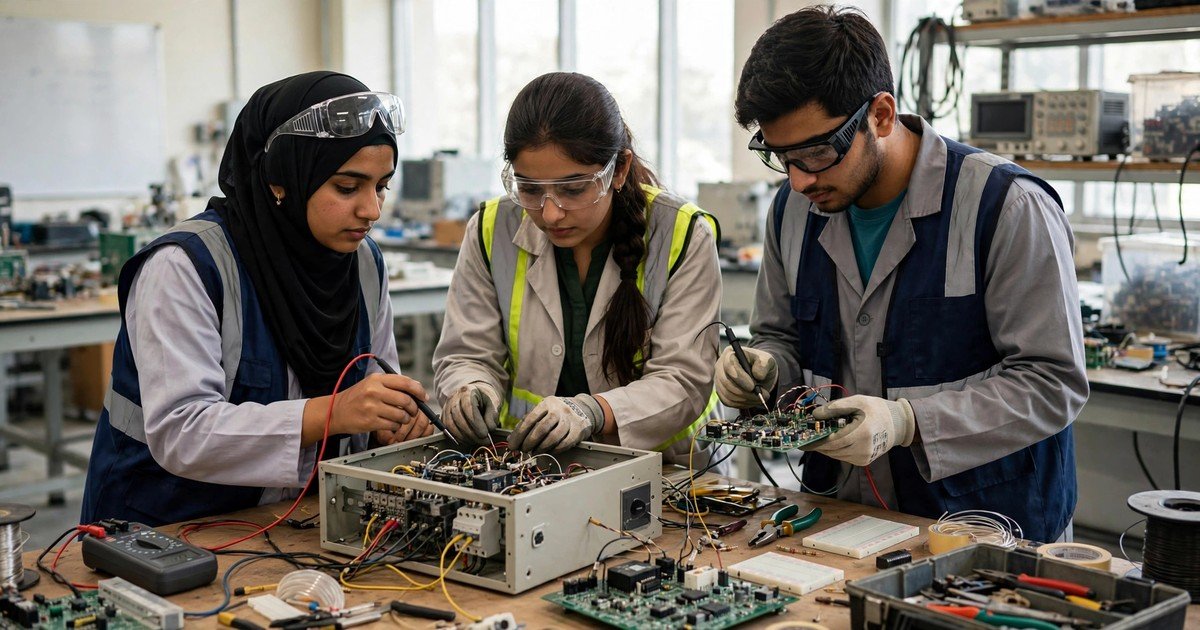
Electrical engineering is taught at public engineering universities and private universities across Pakistan. The BE Electrical Engineering programme covers power systems, electronics, control systems and telecommunications, with laboratory and project work in every year. The degree is accredited by the Pakistan Engineering Council, and admission is usually through an entry test such as ECAT or the university’s own test, on merit.
Before applying for any scholarship, confirm that your institution and your programme are recognised. Most scholarship schemes only support students enrolled in recognised institutions, and some schemes only cover public sector universities. If you are studying at a private institution, check the scheme’s rules carefully, because a scholarship that covers public universities may not cover your institution. Public sector universities generally charge a lower fee than private institutions, which is itself a form of relief for many families. Our scholarships for engineering students guide is a useful companion guide for electrical engineering students preparing for entry tests and admission.
Types of Scholarships for Electrical Engineering Students
Scholarships for electrical engineering students fall into a few broad groups. The first group is need-based scholarships, given to students whose family income is below a limit set by the scheme. The Higher Education Commission’s need-based scholarship is the best-known scheme in this group, and it is offered through the financial aid offices of partner universities. These awards are usually the most useful for students from low-income families, because they are based on need rather than on very high marks.
The second group is merit scholarships, given to students with strong academic results. Universities usually award these themselves, often as a full or partial fee waiver for students who top their class or their batch. Some private universities also offer a merit scholarship at the time of admission to students with outstanding intermediate results. Merit scholarships are usually renewed only if the student keeps a high grade point average. Merit awards are among the scholarships for electrical engineering students offered directly by universities.
The third group is provincial and special-category scholarships. The Punjab Educational Endowment Fund, PEEF, is the largest provincial scheme, and other provinces and regions have their own endowment funds and scholarship programmes. There are also schemes for specific groups, such as children of government employees, students from remote districts, students with disabilities, and orphans.
Electrical engineering students can apply for the general need-based and merit scholarships that cover all disciplines, and for engineering-specific awards announced by power companies, telecommunication firms and industry donors. Some employers in the power and telecom sectors fund engineering students, usually through the university, so the financial aid office is the first place to ask.
The provincial funds are a major source of scholarships for electrical engineering students across Pakistan.
HEC Need-Based Scholarships for Electrical Engineering Students
Eligibility usually depends on financial need, which is checked through the family’s income and assets, and on academic standing. Students who are already receiving another major scholarship may not be eligible, and the scheme usually does not cover students who have already completed a degree at the same level. The exact rules are published in the scheme’s announcement.
PEEF and Provincial Scholarships for Electrical Engineering Students
The Punjab Educational Endowment Fund, PEEF, is one of the largest scholarship schemes in Pakistan. It supports talented and deserving students, including those in electrical engineering degrees, in Punjab and in some partner institutions in other provinces. PEEF has several categories, including scholarships for students in public sector institutions and special quotas for categories such as orphans, children of government employees in lower grades, and students from minority communities. PEEF is one of the largest providers of scholarships for electrical engineering students in Pakistan.
Other provinces have their own schemes, and students in Sindh, Khyber Pakhtunkhwa, Balochistan, Azad Jammu and Kashmir and Gilgit-Baltistan should check the programmes announced by their provincial government and their provincial higher education commission. PEEF and provincial scholarships usually require a domicile of the relevant province or region, a minimum grade in the previous examination, and proof of family income. The award is normally for one academic year and can be renewed if the student keeps the required grades. Our PEEF scholarship guide explains the categories and the application process.
Ehsaas Undergraduate Scholarship for Electrical Engineering Students
The Ehsaas Undergraduate Scholarship is a federal need-based programme for students enrolled in public sector universities. It is aimed at students from low-income families, and it covers the tuition fee and, in many cases, a living allowance. Electrical Engineering students in public universities can apply when applications are open, through their university’s financial aid office and the programme’s online portal. The Ehsaas Undergraduate Scholarship is another of the scholarships for electrical engineering students enrolled in public universities.
The programme uses a need assessment, and applicants are usually asked to give details of family income, the number of dependents, and the family’s assets. Students who are already receiving another scholarship for the same purpose may not be eligible. The exact eligibility rules, the documents required and the last date are announced for each cycle, and they should be read from the official portal rather than from a social media post. A form with missing documents or wrong income details is usually rejected at the first stage, so apply early and keep copies of everything you submit.
University Merit Scholarships for Electrical Engineering Students and Fee Concessions
Almost every university in Pakistan offers some form of merit scholarship or fee concession to its own students. In electrical engineering, these are usually awarded to students who secure the top positions in their class or who enter the programme with outstanding intermediate results. Some universities give a full tuition waiver to the top student of each batch, and a partial waiver to the next few. Private institutions often have the most generous merit schemes, because they use scholarships to attract strong students, so compare scholarship policies as well as fees when choosing an institution. University merit scholarships are among the scholarships for electrical engineering students offered directly by their own universities.
Need-based fee concessions are also common. A student whose family faces a genuine financial difficulty can apply to the university for a concession, usually with proof of income and a written application. Because the BE Electrical Engineering degree runs for several years, most scholarships are awarded for one year at a time and renewed on good academic standing.
Who Can Apply
Most scholarships for electrical engineering students are open to students who are enrolled in a recognised BE Electrical Engineering programme in Pakistan. Some schemes are only for public sector universities, while others cover private institutions as well. Some schemes are only for students in a particular province, and the domicile of the student decides eligibility. A few schemes are only for female students, for orphans, for students with disabilities, or for children of government employees.
Academic standing is almost always a condition. Need-based schemes usually ask for a minimum grade in the previous examination and require the student to pass all subjects in the current year. Financial need is checked through documents such as the father’s income certificate, salary slip or tax record, and a statement of family assets. Give honest and complete information; a false statement found later can lead to the scholarship being cancelled and the amount being recovered.
How to Apply for Scholarships for Electrical Engineering Students, Step by Step
The application process is similar for most scholarship schemes. Follow these steps for each scheme you apply for: The steps below work for most scholarships for electrical engineering students.
- Find out which scholarships are open. Check the HEC website, the PEEF website, the Ehsaas portal, your provincial government’s announcements, and your university’s financial aid office and notice board at the start of each academic year.
- Read the eligibility rules for the scheme carefully. Check whether it covers BE Electrical Engineering students, whether it covers your type of institution, whether your domicile matches, and what academic and income conditions apply.
- Collect the documents you will need, usually your CNIC or B-Form, your father’s CNIC, your matric and intermediate certificates and marks sheets, your university admission letter or enrolment proof, an income certificate or salary slip, your domicile certificate, and recent photographs.
- Fill in the application form completely and honestly. Enter your name and your father’s name exactly as they appear on your matric certificate, and give correct income figures. An incomplete form is usually rejected without a second chance.
- Submit the form before the closing date announced for the scheme, through the channel the scheme asks for, whether that is an online portal, the financial aid office, or a posted application. Keep a copy of the submitted form and any receipt or tracking number.
- Appear for an interview or a verification visit if you are called. Some schemes check the family’s circumstances through an interview or a home visit. Answer honestly and keep your documents ready.
- Check the result through the official channel announced by the scheme. If you are selected, follow the instructions for accepting the award, including any bank account details or undertaking that is asked for, within the time given.
Apply for more than one scheme if the rules allow it, because a single application may not succeed. But read the rules first: some schemes do not allow a student to hold two major scholarships at the same time, and you may have to choose one if you are selected for both.
Common Mistakes to Avoid With Scholarships for Electrical Engineering Students
The most common mistake is applying late. Scholarship closing dates are firm, and a late application is not accepted even if the student is deserving. Mark the closing date as soon as a scheme is announced, and submit the form at least a few days early. For scholarships for electrical engineering students, applying late and applying for only one scheme are the two most common mistakes.
The second mistake is applying for only one scholarship. Many students apply for a single famous scheme and give up when they are not selected, even though a smaller provincial or university award was also open. Apply for every scheme you are eligible for, and treat each application as a separate chance.
The third mistake is giving wrong or incomplete information. A wrong income figure, a missing document, or a name that does not match the matric certificate can lead to rejection. Check every entry before you submit, and keep copies so you can prove what you submitted.
The fourth mistake is never visiting the financial aid office. Many scholarships, especially university and donor-funded awards, are announced only on the notice board or through the financial aid office. Students who never visit the office miss these chances entirely. Visit the office in the first week of each semester and ask what is open. Never pay anyone who promises a scholarship; no genuine scheme asks for money to process an application.
Can a BE Electrical Engineering Student Apply for Scholarships for Electrical Engineering Students Through HEC?
Yes, if the student is enrolled in a public sector university that is a partner in the HEC need-based scholarship programme and meets the scheme’s need and academic conditions. The application is made through the university’s financial aid office, and the exact rules for the year are published in the scheme’s announcement.
Is PEEF Available as Scholarships for Electrical Engineering Students?
PEEF supports talented and deserving students in professional degrees, including electrical engineering, subject to the categories and conditions announced for the year. Eligibility usually depends on the student’s domicile, the type of institution, and academic and need conditions. The details are published on the PEEF website and through partner institutions.
Closing Note
A electrical engineering degree is a long and demanding journey, but financial support is available for students who look for it early and apply properly. Start in your first semester: visit the financial aid office, note the closing dates of the HEC, PEEF and Ehsaas schemes, and apply for every scheme you are eligible for. Keep your grades strong, because most scholarships are renewed only on good academic standing. A scholarship is not a favour; it is support for a student who is working hard, and it is worth the effort of a careful application. In short, scholarships for electrical engineering students reward a strong academic record and careful, early preparation.
Academic honesty note: apply only through official portals and your university’s financial aid office, and never pay anyone who promises a scholarship, a seat, or a fee waiver for money. Submit your own documents, give honest income details, and trust only the official announcements for amounts, dates and eligibility.
Scholarships for Electrical Engineering Students: Documents and Deadlines
Most scholarships for electrical engineering students ask for the same core documents, so prepare a folder before any deadline opens. You will usually need your CNIC or B-Form, your father’s CNIC, your matric and intermediate certificates and transcripts, your university admission letter, and recent passport-size photographs. Need-based scholarships for electrical engineering students also ask for proof of family income, such as salary slips, a pension book, or an income certificate from the local revenue office.
Deadlines are the part students get wrong most often. Each scheme announces its own closing date, and late applications are not accepted, so check the official website of every scheme you apply for and write each date in one place. Scholarships for electrical engineering students open at different times of the year: HEC and PEEF usually open in the first half of the academic year, while university merit awards follow the admission calendar. Apply early so you have time to fix a missing document.
Keep a scanned copy of every document on your phone as well as the originals, because online forms ask you to upload them. If a document is missing, ask your university’s financial aid office or your college for a certified copy well before the deadline. A complete file, submitted early, is the simplest way to keep your application for scholarships for electrical engineering students in the running.
Scholarships for Electrical Engineering Students at Private Universities
Private universities in Pakistan charge higher fees than public universities, so scholarships for electrical engineering students at private institutions matter even more. Most private universities offer merit scholarships for electrical engineering students with strong intermediate results, and many reduce the fee for the top students in each batch. Some also offer need-based fee concessions, sibling discounts, and special awards for students from their own feeder colleges.
Ask the admissions office for the written scholarship policy before you pay the first fee instalment, and confirm whether the award is renewed every semester or only for the first year. Compare the net fee after the scholarship, not the headline fee, when you choose between universities. Private-sector scholarships for electrical engineering students can also come from power companies and telecom firms that sponsor students at partner universities, so check the university’s industry liaison office, which often knows about scholarships for electrical engineering students funded by employers, as well as the financial aid office.
Scholarships for Electrical Engineering Students: Final Checklist
Before you submit any application, run through this final checklist for scholarships for electrical engineering students. Confirm that your university and your BE Electrical Engineering programme are recognised, that you meet the scheme’s eligibility rules, and that every document in your file is current and attested. Check the closing date twice, and submit your application for scholarships for electrical engineering students through the official portal or the university office named in the announcement, never through an agent who asks for payment.
Apply to more than one scheme, because no single application for scholarships for electrical engineering students is guaranteed. Keep copies of every form you submit and every receipt you receive, and note the date you applied and the reference number if one is given. If you are shortlisted, keep your phone switched on and check your email regularly, because interview calls for scholarships for electrical engineering students often come with only a few days’ notice.
Finally, remember that a scholarship is a start, not a finish. Most awards are renewed only if you keep the required grade point average, so plan your studies from the first semester. With the right preparation, scholarships for electrical engineering students can carry you from admission to graduation without the fee becoming a reason to stop.