AIOU 4937: BS Islamic & Arabic (All Groups) Capstone Project — Complete Guide
The aiou 4937 bs islamic arabic project is the research course that completes the BS Islamic & Arabic programme, and this guide shows you how to do it well. If you need clear, practical help with the aiou 4937 bs islamic arabic project — working with manuscripts, planning chapters, working with a supervisor and writing up your study — the sections below cover every stage, from approval to the final file.
What Is the AIOU 4937 BS Islamic Arabic Project?
The Capstone Project numbered 4937 is the research course of the BS Islamic & Arabic (All Groups) programme at Allama Iqbal Open University. It is assessed entirely on a written project: there is no assignment, no quiz and no paper for this code. With a supervisor’s approval you select a topic, work through the sources, and submit a structured file that presents your study and its conclusions. Like the other capstones of the programme, 4937 is taken only once in the whole programme, and it rewards students who start early and read carefully over those who write quickly at the end.
Working With Manuscripts: A Project Pattern
A distinctive option for 4937 is a project involving manuscripts (makhtutat) — the handwritten witnesses through which classical Islamic scholarship reached us. An undergraduate project cannot edit a whole book, but it can describe and study a defined portion: introducing one manuscript held in a known library, identifying its author, copyist and date, comparing its opening folios with the printed edition, or tracing how a short treatise travelled between collections. Such work teaches tahqiq — textual verification — at an honest scale.
If no manuscript collection is within your reach, the same method applies to early printed editions: comparing two editions of one short text and documenting their differences is genuine textual research. That comparison is a practical starting point for the aiou 4937 bs islamic arabic project when a manuscript itself cannot be reached.
Which Semester Does 4937 Fall In?
4937 belongs to the final year of the four-year BS, generally the 7th or 8th semester. Manuscript work in particular draws on the programme’s accumulated Arabic training and its courses on the classical disciplines, so the university schedules the project after those foundations are laid. The scheme of studies attached to your own admission is the final word — confirm from your LMS enrollment that the code is due, and give yourself the full semester by settling the topic at once. Confirm the timing for the aiou 4937 bs islamic arabic project in your own LMS enrollment before you plan your reading.
Planning Your AIOU 4937 BS Islamic Arabic Project
A realistic timetable turns the aiou 4937 bs islamic arabic project from a source of stress into a steady routine. Work backwards from the LMS submission date and divide the semester into reading, manuscript study, drafting and revision, giving each stage a deadline you write down. Aim to finish your reading and manuscript work early, so the writing stage never feels rushed, and keep a simple notebook where every useful quotation, observation and reference is recorded the day you gather it.
Meet your supervisor early and arrive with two or three topic ideas, each with a note of the sources available. Ask directly which idea is narrow enough to finish in one semester and which manuscript or edition you can realistically obtain. Agree the final topic in writing, together with a deadline for your first draft, so the aiou 4937 bs islamic arabic project starts with a plan both sides understand.
Chapters of a 4937 Project
Begin with an introduction that states the text or question under study and why it merits attention. An early chapter should set out the background: the author and his period for a textual study, or the state of earlier research for a thematic one. The middle chapters present your own work — description, comparison, analysis — in a sequence the reader can audit, quoting the sources precisely and noting editions and folio or page references.
A conclusion gathers the results without inflating them, and the bibliography records every source in a uniform style. Where photographs or catalogue records of a manuscript are used, acknowledge the holding library as the source. A chapter plan like this keeps the aiou 4937 bs islamic arabic project readable from the first page to the last.
Describing and Comparing Manuscripts
Good manuscript work begins with careful description. Note the manuscript’s physical features — its size, paper, script, number of folios and any seals or ownership notes — and record the author, copyist and date exactly as they appear. Then compare a defined portion with the printed edition, listing every difference you find: missing words, added phrases or variant readings. That patient, evidence-based comparison is the core of the aiou 4937 bs islamic arabic project.
For official dates and programme news, check the Allama Iqbal Open University website at aiou.edu.pk, so your planning rests on official information rather than rumours. While you work on the aiou 4937 bs islamic arabic project, ask your supervisor which libraries and catalogues are realistic for you, and study any digital images only with permission, acknowledging the holding library as the source of every image you use.
Your Supervisor’s Role
Expect the supervisor of 4937 to test feasibility first: is the manuscript accessible, is the edition available, is the portion small enough? They will also set the standard for citation and transliteration and review your drafts in stages. Send a sample of the core work — a few pages of description or comparison — before producing the whole file, because method errors caught on a sample are cheap to fix. Keep the approval of the topic and all feedback in writing; together they document the project’s progress if any question arises later.
Writing and Referencing Your AIOU 4937 BS Islamic Arabic Project
Write in short, clear paragraphs and let each one make a single point, supported by evidence from the manuscript or edition in front of you. Quote sources precisely, note editions and folio or page references for every quotation, and keep your transliteration consistent throughout. Record every source in your bibliography as you use it, because careful referencing is what makes the aiou 4937 bs islamic arabic project trustworthy in an examiner’s eyes.
Final Checklist Before You Submit
Before you hand in your file, run through a short checklist. Is your topic the one your supervisor approved? Is every quotation traced to a source in your bibliography? Have you read the whole file aloud once, to catch repeated sentences and typing errors? A careful final read is often what separates a good aiou 4937 bs islamic arabic project from an average one. If you can answer yes to each question, your aiou 4937 bs islamic arabic project is ready — submit it with confidence and keep a copy for yourself.
FAQs About AIOU 4937
Q: Do I need to travel to a famous library for a manuscript topic?
No. Many madrasa and college libraries hold manuscripts, and some major collections publish catalogues and digital images that can be studied remotely with permission. Your supervisor can confirm what access is realistic for you.
Q: What if the manuscript I chose turns out to be a different work than catalogued?
That discovery is itself research — misattributions are common in old catalogues. Document what you found, inform your supervisor, and adjust the study; an honest correction impresses examiners more than silent confusion.
Q: How much of the project should be my own analysis?
The majority of the main chapters. Background and summary are necessary scaffolding, but the marks live in the work only you could have produced from the sources in front of you.
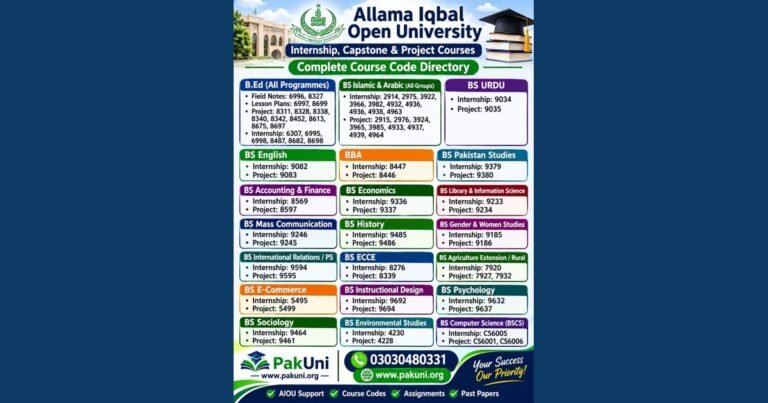
Complete Directory of Project & Internship Codes
This article is part of our complete directory of AIOU Capstone Project, Internship, Field Notes and Lesson Plan codes for all ODL programmes. To check the codes of any other programme, see the full directory here: AIOU Capstone Project & Internship Course Codes — Complete Directory.
Need Help With Your Capstone Project?
Agar aap ko apne Capstone Project (4937) mein madad chahiye, to hum se WhatsApp par rabta karein.