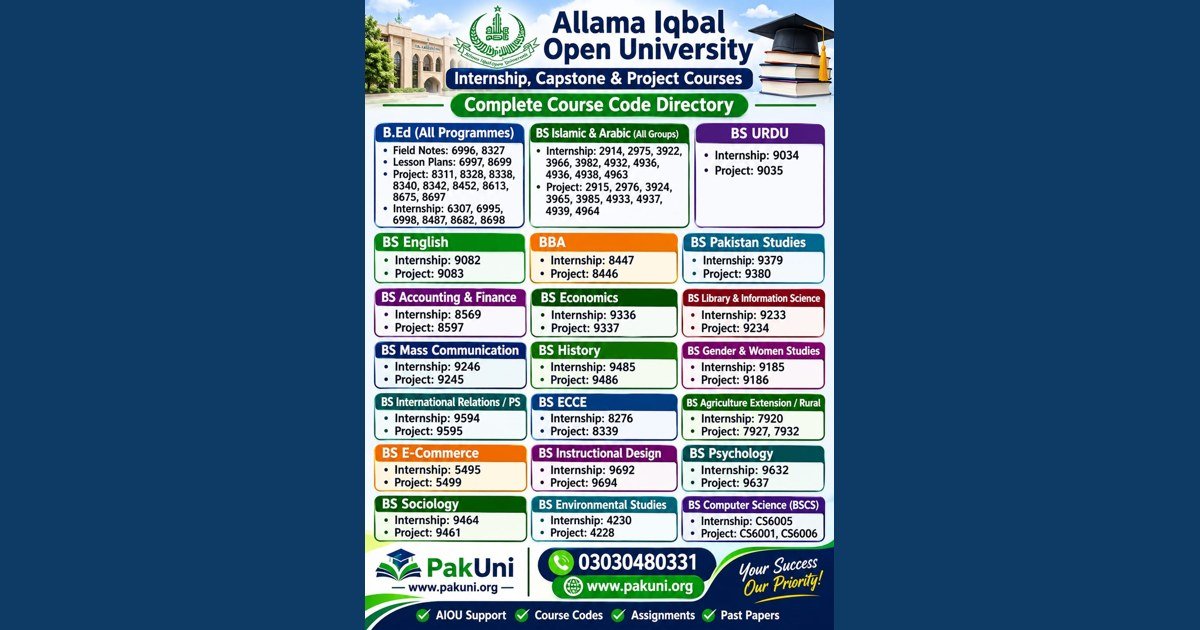
AIOU Capstone Project & Internship Course Codes — Complete Directory (ODL Programmes)
AIOU Capstone Project: Complete Directory for ODL Students
For the convenience of students, this post shares a complete directory of all AIOU Capstone Project and Internship course codes for ODL programmes, so that every student can easily check the project and internship codes of their own programme in one place.
In BS, BBA and B.Ed (4-year) programmes, the Capstone Project and Internship fall in the 6th, 7th or 8th semester. In BS, BBA and B.Ed (2.5-year) programmes, they fall in the 3rd, 4th or 5th semester.
Each of these codes comes only once in the whole programme, and it can fall in a different semester for different students. These codes have no assignment, no quiz and no paper.
To find your AIOU Capstone Project code, first check the scheme of studies for your own programme, because each code belongs to one programme and appears only once in it. Match the code with your programme name and your current semester, and if the code on your admission or course list looks different, confirm it with your tutor or your regional office before you register the course. The official website of Allama Iqbal Open University lists the current programmes and rules, and this site also has an AIOU online admission form guide that explains the admission steps for new students.
How the AIOU Capstone Project Works
For the Capstone Project, the student gets the topic approved by the supervisor, completes the research, and uploads the project file on the LMS.
How the Internship Works
For the Internship, the student works for 6 weeks at an organisation related to their programme, prepares an internship report, obtains a certificate from the organisation, and uploads the report together with the certificate on the LMS.
Once your AIOU Capstone Project is approved and your research is complete, keep a copy of your final report and every receipt from the LMS upload, because these are your proof that the work was submitted. Check the result on the student portal after the semester ends, and if the result does not appear, contact your tutor or regional office with your roll number and course code. Do not pay anyone who promises to write the project or arrange the result for money, and trust only the official announcement for any deadline or rule.
The directory below lists the AIOU Capstone Project and internship codes by programme, so find your programme name first and then read across to the Internship and Project columns. The B.Ed and BS Islamic and Arabic codes are listed first, because they cover several groups, and all other programmes follow in the table. If your programme is not listed, or if two codes look the same, check the scheme of studies for your programme before you choose, because the code on your admission list is the one that counts.
AIOU Capstone Project Course Code Directory

B.Ed (All Programmes)
Field Notes: 6996, 8327 · Lesson Plans: 6997, 8699 · Project: 8311, 8328, 8338, 8340, 8342, 8452, 8613, 8675, 8697 · Internship: 6307, 6995, 6998, 8487, 8682, 8698
BS Islamic & Arabic (All Groups)
Internship: 2914, 2975, 3922, 3966, 3982, 4932, 4936, 4938, 4963 · Project: 2915, 2976, 3924, 3965, 3985, 4933, 4937, 4939, 4964
Other Programmes
| Programme | Internship | Project |
|---|---|---|
| BS Urdu | 9034 | 9035 |
| BS English | 9082 | 9083 |
| BBA | 8447 | 8446 |
| BS Pakistan Studies | 9379 | 9380 |
| BS Accounting & Finance | 8569 | 8597 |
| BS Economics | 9336 | 9337 |
| BS Library & Information Science | 9233 | 9234 |
| BS Mass Communication | 9246 | 9245 |
| BS History | 9485 | 9486 |
| BS Gender & Women Studies | 9185 | 9186 |
| BS International Relations / PS | 9594 | 9595 |
| BS ECCE | 8276 | 8339 |
| BS Agriculture Extension / Rural | 7920 | 7927, 7932 |
| BS E-Commerce | 5495 | 5499 |
| BS Instructional Design | 9692 | 9694 |
| BS Psychology | 9632 | 9637 |
| BS Sociology | 9464 | 9461 |
| BS Environmental Studies | 4230 | 4228 |
| BS Computer Science (BSCS) | CS6005 | CS6001, CS6006 |
Need Help With Your Project or Internship?
Agar aap ko apne Capstone Project ya Internship report mein madad chahiye, to hum se WhatsApp par rabta karein.
How to Find Your AIOU Capstone Project Code
Find your code in your scheme of studies first. The AIOU capstone project code is listed for your programme, and it is different for BS, BBA and BEd. Check the programme name, the duration and the semester in the scheme, and match it to the directory above. AIOU capstone project codes are given once in the whole programme, so the code for your programme will not repeat in another semester.
Check the semester in which your AIOU capstone project falls. In BS, BBA and BEd 4-year programmes it falls in the 6th, 7th or 8th semester, and in 2.5-year programmes it falls in the 3rd, 4th or 5th semester. AIOU capstone project work starts only when that semester arrives, so plan your other courses around it. Do not start the project early without your supervisor, because the topic must be approved first.

Confirm the code with your tutor or regional office. The AIOU capstone project directory above lists the codes, but your tutor can confirm that the code is the one for your batch. AIOU capstone project codes can change between batches, so a quick confirmation saves you from working on the wrong code. Keep the confirmed code in writing, with your programme and semester.
Keep a folder for your AIOU capstone project from the start. Put the scheme of studies, the code, the supervisor name and the approval letter in one folder. AIOU capstone project work takes a whole semester, and a clear folder stops you from losing a document that you need for submission. Check the folder at the start of each week.
Read the rules before you choose a topic for the AIOU capstone project. The topic must fit your programme, it must be approved by your supervisor, and it must be doable in the time you have. AIOU capstone project topics that are too broad are hard to finish, so choose a narrow, clear topic that you can study with the data you can collect.
Planning Your AIOU Capstone Project Week by Week
Plan your AIOU capstone project in weeks, not in one rush. In the first weeks, choose your topic, get it approved, and read the key books and papers. The AIOU capstone project needs a clear question, so write it down in one sentence. If you cannot state it in one sentence, the topic is still too broad.
Use the middle weeks for data and writing. The AIOU capstone project is written chapter by chapter, so draft one chapter at a time and show it to your supervisor. AIOU capstone project supervisors can help most when they see a draft early, not a full report in the last week. Keep your notes and your sources together.

Check your references as you write the AIOU capstone project. Every fact, quote and table needs a source, and your reference list must match your text. AIOU capstone project reports are checked for plagiarism, so write in your own words and cite your sources. A clear reference list saves you from a late correction.
Keep a backup of your AIOU capstone project file. Save it on your computer, on a USB and in your email. AIOU capstone project work lost in the last week is hard to rewrite, so back it up every time you write. Check the file once a week, and open it to be sure it is not damaged.
Completing Your Internship in Six Weeks
An internship lasts six weeks, and the time passes quickly. Choose an organisation that fits your programme, get it approved, and agree your duties in writing before you start. Keep a daily diary of what you did, who you met and what you learned. That diary becomes the evidence for your report, and it is far easier to write from a diary than from memory.
Ask questions in your first week. Your supervisor at the organisation expects a new intern to ask, and a clear question shows interest. Learn the names of the people you work with, learn the office routine, and offer to help with real work. An intern who is reliable and curious is remembered, and a good reference from an internship can help with your first job.

Write your internship report in the same order as your project report. Start with an introduction, then describe the organisation, then your duties week by week, then what you learned, and end with a conclusion. Keep your report clear, short and honest. If a task did not go well, say what happened and what you learned from it. A report that is honest is stronger than one that claims everything was perfect.
Final Checklist Before You Submit
Use this short checklist. First, confirm your code, your topic and your supervisor. Second, check that your report is complete, with every chapter, table and reference in place. Third, check your format, your file name and your PDF. Fourth, submit before the last date and save your proof. For the wider journey, see the AIOU admission guide, the AIOU solved assignments hub and the AIOU past papers page, and check official news on the AIOU official website.
Start today. Find your code in the directory above, confirm it with your tutor, and plan your semester week by week. With a clear topic, a good supervisor and a steady routine, you will finish on time, with work you can be proud of.
Choosing a Supervisor and a Topic That Fits
Choose a supervisor you can reach. A good supervisor answers messages, meets you on time and reads your drafts. Ask your tutor who supervises in your subject, and talk to senior students about who is helpful. A supervisor who is too busy to meet you will slow your work, however good their knowledge is.
Pick a topic you can finish with the data you can collect. A topic that needs a survey of hundreds of people is hard in one semester, while a topic that uses data from one school, one office or one small group is doable. Check what data you need, where you will get it, and how long it will take. If the data is not available, change the topic early, not in the middle of the term.
Write your research question in one sentence, and keep it in front of you while you work. Every chapter, every table and every conclusion should answer that question. If a section does not answer it, cut it or rewrite it. A clear question is the best guide for a long report, and it helps your supervisor give you useful feedback.
Writing Your Report Chapter by Chapter
Write the introduction last, even though it comes first in the report. The introduction should say what you studied, why it matters and how you studied it, and you can only write that well after the rest is done. Draft the middle chapters first, then the conclusion, then the introduction. That order saves you from rewriting the introduction three times.
Keep your tables and figures simple. A table should have a clear title, clear headings and only the numbers that matter. A figure should be labelled, and the text should say what it shows. Do not copy a table from a book without understanding it, and do not add a figure that you do not explain in the text.
Check your language before you submit. Short sentences are easier to read than long ones, and simple words are better than long ones you are unsure of. Read your report aloud, and rewrite any sentence that sounds unclear. Ask a friend to read one chapter, and listen to what confuses them. A report that is easy to read is easier to mark well.
Preparing for the Viva and the Final Submission
Prepare for the viva by knowing your own report. Read it once more, and note the main findings, the method and the limits of your work. The examiners will ask why you chose the topic, how you collected the data, and what you found. Answer in your own words, and be honest about what you could not do. A short, honest answer is better than a long, invented one.
Check the submission format before the last date. The report must be bound or saved as a PDF in the format your university asks for, with the title page, the declaration and the approval page in order. Check the font, the spacing and the page numbers. A report that looks neat is taken seriously, and a report that is messy is hard to read.
Keep a copy of your final report, your approval letter and your submission receipt. You may need them for a job, for further study, or for a verification check. Store them in one folder, on your computer and in your email. Your final year work is a record of what you can do, so keep it safe.
Common Mistakes to Avoid in Your Final Year
Do not leave the report until the last week. A report written in a rush shows in every chapter, and a supervisor cannot read a full draft in one day. Plan your weeks, write a little each week, and show drafts as you go. A steady pace is the best way to finish on time, and it gives you room to fix problems when they appear.
Do not copy text from the internet or from a friend. Reports are checked for copied work, and a copied report can be rejected. Write in your own words, cite your sources, and keep your notes. If you use a table or a figure from a book, say where it came from. Honest work is slower, but it is yours, and it will stand up in the viva.
Do not ignore your supervisor. A supervisor is there to guide you, not to write the report for you. Meet them on the dates you agree, bring a draft, and listen to their feedback. If you disagree with a suggestion, say so politely and explain why. A good working relationship with your supervisor makes the whole semester easier.
What Happens After You Graduate
After you graduate, keep your degree, your transcript and your final report in one place. Employers and universities will ask for them, and a clear folder saves time. Make copies, and keep the originals safe. Your final year work is proof of what you can do, so treat it as an important record, not as a file to forget.
Think about your next step while you are still a student. Some graduates go straight to work, some apply for a job in the public sector, and some continue to a master’s degree. Talk to your teachers, your family and your friends about what fits you. A clear plan after graduation is easier to make while you still have the support of your university.
Stay in touch with your classmates and your teachers. The people you studied with will become your professional network, and the teachers who supervised you can write a reference for your first job. A short message now and then keeps those links alive, and a good reference can open a door that a degree alone cannot.
How to Use Your Directory Code in Each Semester
Check your code at the start of each semester, not only in the final year. The directory above lists codes by programme, so find your programme and note the code, the semester and the type of work. A code that falls in the sixth semester will not appear in the fifth, so a quick check at the start of the term tells you what is coming.
Talk to your tutor if your programme is not in the directory, or if your batch follows a different scheme. Schemes can change between batches, and your tutor can confirm the right code for your batch. Do not use a code from another programme, because the syllabus, the supervisor and the marking will not match.
Keep your scheme of studies with your code. The scheme shows every course, every credit hour and every semester, and it is the document your tutor will check. Print it or save it on your phone, and bring it to any meeting about your final year. A clear scheme saves a long discussion, and it helps you plan your whole degree, not just one semester.
Plan your final year with your other courses in mind. The final year has the most work, and a heavy semester with a project, an internship and two hard courses is difficult. If you can, spread your hard courses across semesters, and keep the final semester for the project and the internship. A balanced plan is better than a rushed one, and your marks will show it.
Ask senior students how they managed their final year. They can tell you which supervisors are helpful, which topics are doable, and which organisations take interns. Listen to their advice, but make your own choice. Your topic, your supervisor and your organisation should fit you, not someone else.
AIOU Capstone Project: Quick Answers to Common Questions
Many students ask when the AIOU capstone project starts. The AIOU capstone project starts in the semester given in your scheme of studies, usually the sixth, seventh or eighth semester. Check your scheme, and ask your tutor if you are unsure. The AIOU capstone project is a full course, so it needs a whole semester.
Students also ask how long the AIOU capstone project report should be. The AIOU capstone project report is usually a full report with an introduction, a literature review, a method, results and a conclusion. Follow the format your supervisor gives you, and keep the report clear and complete. The AIOU capstone project is marked on the report and the viva.
Finally, students ask who marks the AIOU capstone project. The AIOU capstone project is marked by a supervisor and an external examiner, and the viva is part of the mark. Prepare for the viva by knowing your report well, and answer in your own words. The AIOU capstone project rewards careful, honest work.