
AIOU 203 Solved Assignment Autumn 2026: General Science (Matric)
AIOU 203 Solved Assignment Autumn 2026: General Science (Matric)
If you are a Matric student at AIOU, the aiou 203 solved assignment autumn 2026 is your General Science course work. General Science teaches you how the world around you works. It covers plants, animals, the human body, air, water, energy and the earth. The course is wide, but the questions follow a clear pattern. Learn the basic facts, give daily life examples, and write short clear answers.
Use this page as a study sample for learning and reference. It is not a paper to copy. You can find more solved work on our AIOU solved assignments hub. Read the sample, understand the ideas, and write your own answers in your own words. Copied assignments can fail or lead to strict action by AIOU. Always check the questions, the assignment count and the marks on your own official question paper first. The questions below are typical questions from the usual pattern and past papers. They are not a copy of your paper.
Quick Facts
| Course Code | 203 |
| Subject | General Science |
| Program | Matric (SSC, 2 year program) |
| Semester | Autumn 2026 |
| Credit Hours | 6 |
| Assignments | 4 assignments |
| Submission | To your tutor, as per the rules for Matric students |
| Deadlines | Assignment 1: 15 December 2026. Assignment 2: 8 January 2027. Assignment 3: 30 January 2027. Assignment 4: 20 February 2027. Confirm on your own question paper. |

What General Science Covers
General Science is a mix of physics, chemistry, biology and earth science at a basic level. You do not need deep maths. You need clear facts and the skill to explain them in simple words. A good answer names the fact, explains it in one or two lines, and gives an example from daily life in Pakistan.
Then the course moves to living things. You learn how plants make food, how animals live and grow, and how the human body works. The human body section is a favourite in exams. Learn the main systems: digestion, breathing, blood flow, and the nervous system. For each system, learn its job, its main parts, and one common health care tip. Short labelled diagrams help a lot in these answers. Even a simple sketch with clear labels can earn extra marks.
How Matric Submission Works
Matric students do not use the same online route as B.Ed students. The new online rule from Autumn 2026 applies to Associate Degree and BA Open Courses students. Matric and FA students still submit their assignments to their tutors, as before. That is why you must know your tutor early in the semester. Your tutor checks your work, gives marks, and sends the record to AIOU.
Check your tutor details on the CMS portal as soon as your admission is confirmed. If you do not know your tutor, read our guide on how to check AIOU tutor information online. Write your assignments on the proper answer sheets, attach the cover page with your name, registration number, course code and assignment number, and keep a copy or photo of each assignment before you hand it in. That copy is your proof if a mark goes missing later.
Assignment No. 1: AIOU 203 Questions and Solved Sample
Check the official question paper for Autumn 2026 before you write. Match each question below against your own paper first. Use the sample ideas, then write in your own words.
Q1. What is matter? Explain its states with examples.
Define matter as anything that has mass and takes up space. Then explain the three common states. Solids have a fixed shape and size, like a stone or a book. Liquids have a fixed size but take the shape of the pot, like water in a glass. Gases spread to fill all the space, like the air in a room. Give one home example for each state. A strong answer also notes that heat can change the state. Ice melts into water, and water turns into steam on heating.
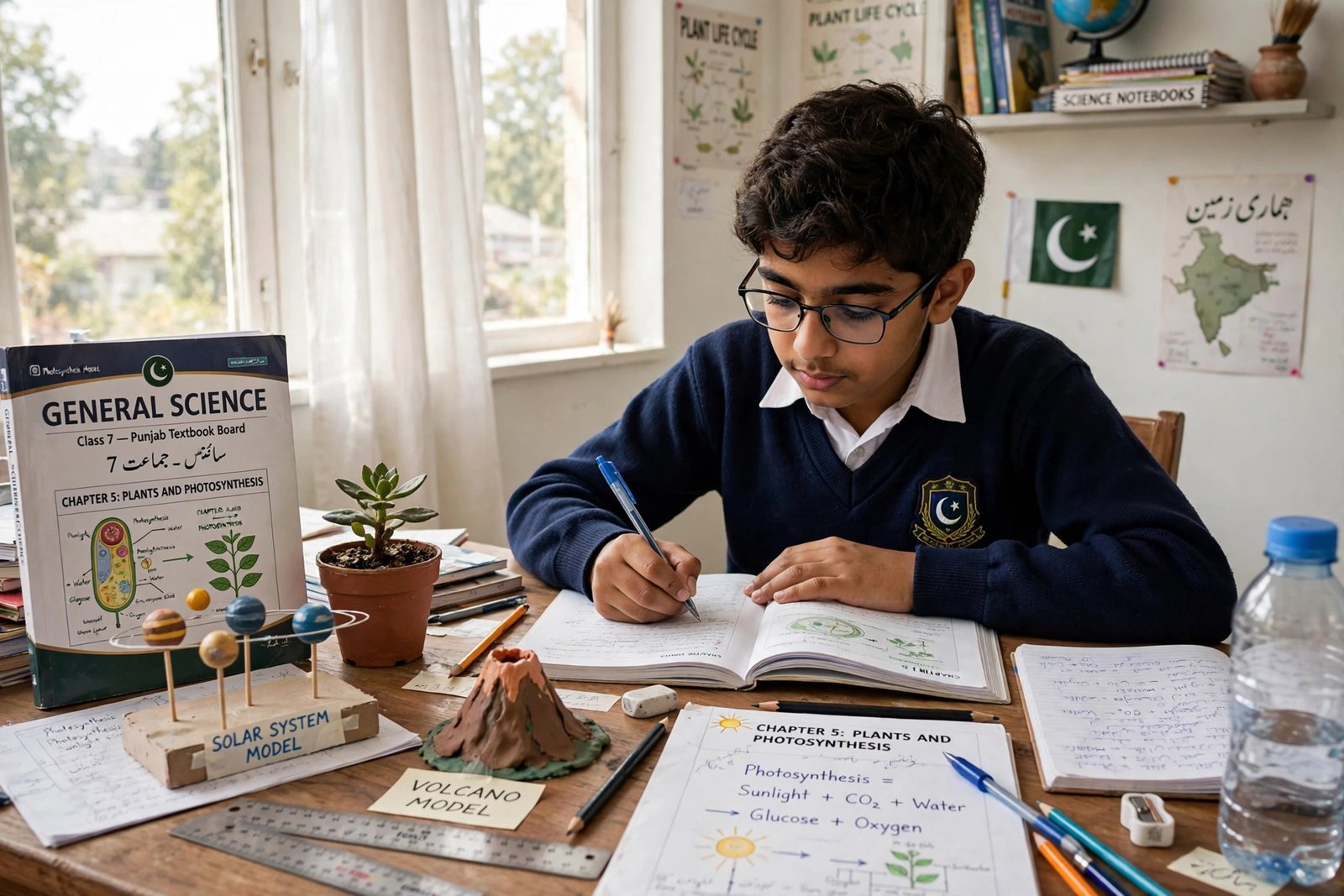
Q2. Explain photosynthesis. Why is it important for life on earth?
Photosynthesis is the process by which green plants make food from sunlight, water and carbon dioxide. The plant takes sunlight with the green part in its leaves, takes water from the soil, and takes carbon dioxide from the air. It makes glucose, which is food, and gives out oxygen. Draw a simple labelled diagram if you can. Then explain why it matters. All food chains start with plants. Humans and animals eat plants or eat animals that eat plants. The oxygen we breathe also comes from this process. Without photosynthesis, life on earth could not go on.
Q3. Describe the human digestive system and its main parts.
List the parts in the order food travels. Mouth, food pipe, stomach, small intestine, large intestine. In the mouth, teeth cut food and saliva starts the work. In the stomach, food mixes with juices and turns soft. In the small intestine, most food is absorbed into the blood. In the large intestine, water is absorbed and the rest leaves the body. Add one care tip. Chew food well, drink clean water, and eat on time. A neat labelled diagram of the system will make this answer stand out.
Assignment No. 2: AIOU 203 Questions and Solved Sample
The second assignment often moves to energy, force and the environment. Keep the same shape: definition, explanation, daily life example.
Q1. Explain the water cycle. How does it help farmers in Pakistan?
The water cycle is the path water takes between the earth and the sky. Heat from the sun turns water from rivers, lakes and the sea into vapour. The vapour rises, cools, and forms clouds. When clouds get heavy, rain falls back to earth. Some rain fills rivers and dams. Some soaks into the ground. For farmers, rain fills canals and wells, and helps crops grow. A diagram with arrows for evaporation, condensation and rain will earn good marks. Add one care point. We must save water and keep it clean, because dirty water harms crops and health.
Q2. What is pollution? Explain air pollution, its causes and its harms.
Pollution means harmful stuff mixed into air, water or soil. Air pollution comes from smoke from cars, factories and brick kilns, and from dust and burning waste. It harms the lungs and eyes, and it can cause cough and asthma. It also harms crops and buildings. In winter, smog in Punjab cities makes the problem worse. Give two simple fixes. Plant more trees, and do not burn waste in the open. A strong answer names the cause, the harm and the fix.
How to Prepare for Assignments 3 and 4
The later assignments test the same skills on new topics. You may face questions on the solar system, simple machines, the human heart, or soil and crops. The method does not change. Read the chapter, note the key facts in your own words, and practise one answer for each main heading. If a question asks you to compare two things, use a small table. A table for living and non living things, or for solids, liquids and gases, is clear and easy to mark.
Common Mistakes to Avoid
A costly mistake is to miss the deadline or the tutor. Matric marks come through your tutor. If you hand in late work with no proof, you have no case. Keep a photo of each assignment, note the date you handed it in, and check your marks in CMS when they are posted. If a mark is missing, our guide on how to check AIOU assignment marks on the CMS portal explains the steps to fix it.
Frequently Asked Questions
How many assignments does 203 have?
Course 203 is a 6 credit hour course with 4 assignments in Autumn 2026. The deadlines are 15 December 2026, 8 January 2027, 30 January 2027 and 20 February 2027. Confirm them on your own official question paper, which is the final source.
Do Matric students submit assignments online?
No, not in the same way as B.Ed students. Matric and FA students submit to their tutors. The Autumn 2026 online LMS rule applies to Associate Degree and BA Open Courses students. If your tutor tells you a different route for your own case, follow your tutor and confirm on the CMS portal.
Where can I find more solved assignments?
Our AIOU solved assignments hub lists the solved samples on this site. A sibling Matric sample is our AIOU 201 solved assignment for Islamiat. Use samples to learn, then write your own work.
General Science rewards steady work. Read one chapter, write its key facts in your own words, and test yourself with one question a day. That habit will carry you through all four assignments and leave you with real science knowledge you can use in daily life. Always check your own official question paper for the final questions, dates and marks.