SAT Preparation for Pakistani Students: Pattern, Scores and Study Plan
The SAT is the standardised test used by many universities in the United States and in other countries for undergraduate admission. For Pakistani students who want to study abroad, a good SAT score can open the door to universities and scholarships that would otherwise be out of reach. This guide explains the pattern of the SAT, how the scores work, and how SAT preparation works, with a study plan that fits a Pakistani student’s background.
One point must be made clearly at the start. The SAT is administered by the College Board, and the test format, the registration process and the test dates are announced by the College Board for each cycle. No fee or date figure is stated in this guide, because fees and dates change and are set by the College Board. Always read the official information on the College Board website before you register.
Quick Facts
| Item | Detail |
|---|---|
| What it is | Standardised test for undergraduate admission, used mainly by US universities |
| Sections | Reading and Writing, and Mathematics, taken digitally on a computer |
| Total score | 400 to 1600 |
| Total time | About 2 hours and 14 minutes, with a short break between sections |
| Maths support | Built-in Desmos graphing calculator and a reference sheet are provided |
| When to take it | When you are ready, with time to retake it if needed |
| Registration | Through the College Board, with test centres in Pakistan |
What the SAT Covers
The SAT has two main sections: Reading and Writing, and Mathematics. The test is now taken digitally on a computer, and the questions adapt to the student. If you do well in the first part of a section, the second part of that section becomes harder. If you struggle in the first part, the second part becomes easier. This adaptive format is the reason the test is shorter than the old paper test.
The Reading and Writing section, the harder part of SAT preparation for most Pakistani students, tests your ability to read passages, understand what they say, and use grammar and punctuation correctly. The passages are short, and the questions ask you to find information, to work out what a word means in context, and to choose the best way to complete a sentence or a passage.
The Mathematics section covers algebra, advanced mathematics, problem solving and data analysis, and geometry and trigonometry. It also includes some questions that ask you to solve real-world problems. You can use a calculator for all questions, and the test provides a built-in Desmos graphing calculator and a reference sheet.
How the SAT Score Works
In SAT preparation, it helps to know that the total score ranges from 400 to 1600. It is the sum of two section scores: Reading and Writing, scored from 200 to 800, and Mathematics, scored from 200 to 800. The total is the sum of the two section scores, so a strong section can lift a weak one, but both sections matter.
Do not fixate on a single number. A good SAT score is one that matches the universities you are applying to. A score of 1200 is good for some universities and weak for others. Look at the range of scores that a university publishes for admitted students, and aim for a score inside that range. If you are below the range, you will need to improve your score or apply to a different set of universities.
The SAT score is only one part of your application. Universities also look at your school record, your personal statement, and the other documents you send, so let your SAT preparation cover the whole application, not only the test. A strong score helps, but a weak school record will still hurt you. Plan your application as a whole, not as a single test score. Our scholarships for Pakistani students guide can help you plan the next step after the SAT, because a good score can also open doors to funding.
SAT Preparation: How to Get Ready
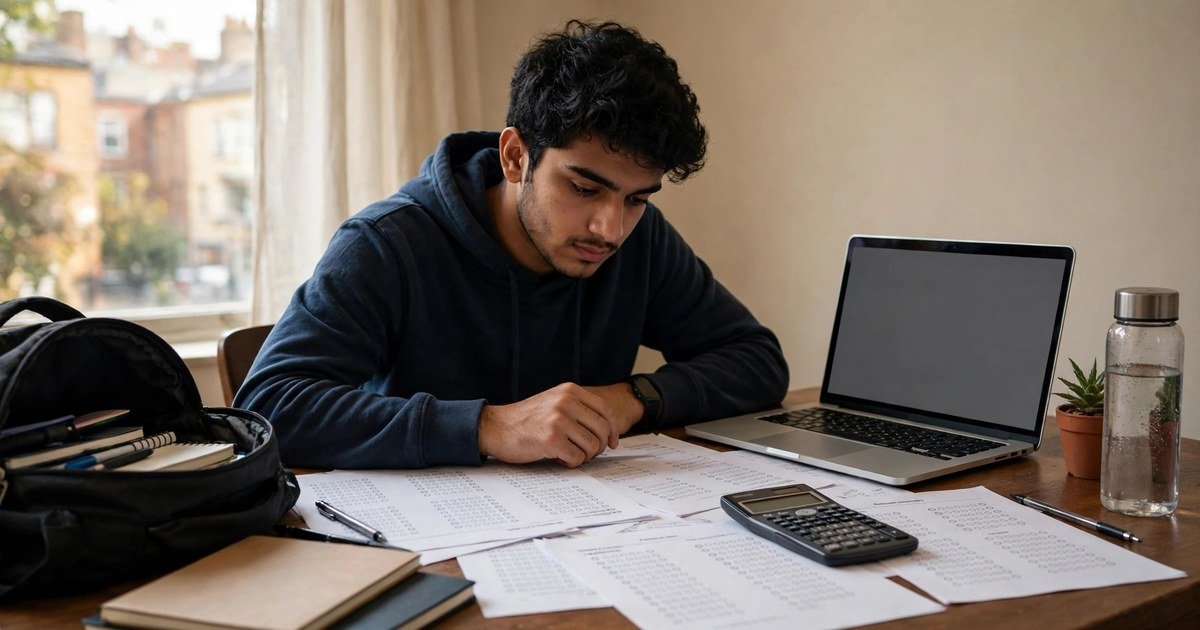
Good SAT preparation takes several months. Start by taking a full-length practice test under timed conditions. The score you get is your starting point, and it shows you where to begin. From there, build a routine that you can follow each day, even if you are also studying for your FSc or A-level examinations.
- Take a full-length official practice test first, under timed conditions, to find your starting score and your weakest section. You cannot plan without a starting point.
- Study the Reading and Writing section every day as part of your SAT preparation. Read English passages, practise comprehension questions, and learn the grammar rules that appear in the test.
- Revise the mathematics topics from the FSc course, and practise setting up and solving problems without a calculator first, then check your work with the calculator.
- Learn the vocabulary that appears in the SAT, but learn it in context, by reading, not by memorising lists of words.
- Practise with official SAT practice tests and questions, because they show you exactly how the real test is framed, and they are the core of good SAT preparation.
- Take full-length mock tests regularly, under real conditions, and review every wrong answer to understand why you made the mistake.
The College Board provides free official practice tests and questions, and these are the best SAT preparation material available. They show the real format of the test, and they include answer keys and explanations. Use them before you buy any other book, because they are free and they are the closest thing to the real test.
The Reading and Writing Section: The Key Challenge
For most Pakistani students, the Reading and Writing section is the hardest part of the SAT, and it deserves the most SAT preparation time. Many Pakistani students are strong in mathematics but weaker in English reading, and this section tests exactly that. If you improve your Reading and Writing score, your total score will rise faster than if you improve your mathematics score by the same amount.
The best way to improve your SAT preparation is to read English every day. Read newspapers, magazines and books in English, and read them for meaning, not just for words. When you read a passage, ask yourself what the writer is trying to say, and what evidence the writer uses. This habit will help you in the test, and it will also help you at university.
For the grammar and writing questions, learn the rules that appear most often: subject-verb agreement, verb tenses, punctuation and sentence structure. Practise these rules with official questions, and check your answers against the explanations. If you do not understand an explanation, ask a teacher or look it up, because a rule you do not understand will keep costing you marks. The HEC USAT test guide can also help you understand how English is tested in other Pakistani entry tests, and the skills you build for the SAT will help you there too.
The Mathematics Section: Play to Your Strength
Pakistani students who have studied mathematics at FSc level usually find the SAT mathematics section manageable, because the topics are familiar. The main difference is the format: the SAT asks you to solve problems and to apply mathematics to real-world situations, not just to repeat a formula. Practise with official questions to learn the format, and learn how to use the Desmos calculator well.
The main risk in the mathematics section is a careless mistake. Students who know the mathematics often lose marks because they misread a question, or because they rush and make a simple error. Slow down, read each question twice, and check your answer before you move on. A few minutes of care can save you several marks.
Keep a list of the topics where you make mistakes, and revise them regularly as part of your SAT preparation. If you keep making the same mistake, go back to the FSc textbook and relearn the topic from the start. Do not move on until you understand it, because the same topic will appear again in the test.

A Simple SAT Preparation Study Plan
A good SAT preparation plan divides your work into three stages. Stage one is learning: take a diagnostic test, find your weak areas, and learn the topics and the rules you do not know. Stage two is practice: study Reading and Writing every day, revise mathematics, and solve official practice questions for each section. Stage three is testing: take full-length mock tests under timed conditions and review your mistakes.
- Stage one — learning: take a diagnostic test, find your weak areas, and learn the topics and the rules you do not know. This stage takes the most time, so start it early.
- Stage two — practice: study Reading and Writing every day, revise mathematics, and solve official practice questions for each section as your SAT preparation deepens. Practise a little every day, rather than a lot in one day.
- Stage three — testing: take full-length mock tests under timed conditions and review your mistakes. A mock test shows you how ready you are, and it teaches you to manage your time.
- Daily routine: study for one to two hours each day, with Reading and Writing first, because it needs the most work, and mathematics second.
- Weekly review: at the end of each week, revise your vocabulary notebook, your grammar rules and your mathematics mistakes, so your SAT preparation stays on track.
Common Mistakes to Avoid
The most common SAT preparation mistake is preparing only for mathematics and ignoring Reading and Writing. Many Pakistani students are strong in mathematics, so they spend most of their time on it, but the Reading and Writing section carries half the total score. If you ignore it, your total score will suffer, even if your mathematics score is perfect.
The second mistake is memorising vocabulary lists without reading. A word learned from a list is easy to forget, and it does not teach you how the word is used. Read English every day, and learn new words from the passages you read. A word you meet in a passage is a word you will remember.
The third SAT preparation mistake is taking too few full-length practice tests. A short practice question is not the same as a full test under timed conditions. A full test teaches you to manage your time, to stay focused for two hours, and to handle the pressure of the real test. Take a full test at least once a month, and more often in the last month before the test.
The fourth mistake is using only unofficial practice material. Unofficial material can be wrong, and it can teach you the wrong format. Use the official College Board practice tests and questions first, and use other books only to supplement them, not to replace them.

What is a good SAT score?
A good SAT score is one that matches the universities you are applying to. A score of 1200 is good for some universities and weak for others. Look at the range of scores that a university publishes for admitted students, and aim for a score inside that range. If you are below the range, you will need to improve your score or apply to a different set of universities.
How long should SAT preparation take?
Most students spend several months on SAT preparation. Three to six months is a common range, with one to two hours of study each day. If you are already strong in English, you may need less time. If your English is weak, you may need more. Start early, so that you have time to retake the test if needed.
Is the SAT mathematics section hard for Pakistani students?
Most Pakistani students who have studied mathematics at FSc level find the SAT mathematics section manageable, because the topics are familiar. The main risk is a careless mistake, not a lack of knowledge. Practise with official questions to learn the format, and learn how to use the Desmos calculator well.
Can I do SAT preparation without joining an academy?
Yes. The College Board provides free official practice tests and questions, and many students do their SAT preparation on their own using these and a good preparation book. An academy can help if you need a teacher to explain the rules, but it is not required. A disciplined student with the official material can prepare well on their own.
When should I take the SAT?
Take the SAT when you are ready, with time to retake it if needed. Many students take it in their first year of A-levels or after FSc, so that they have time for a second attempt. Check the test dates on the College Board website, and register early, because test centres in Pakistan can fill up.
Closing Note
The SAT is a fair test, and it rewards steady work more than last-minute cramming. Start your SAT preparation early, read English every day, and take full-length practice tests until the format feels familiar. If you do that, your score will reflect your work, and your application will be stronger for it.
Academic honesty note: use official practice material, write your own answers, and never pay anyone to take the test for you or to change your score. A score that is not yours is not a real score, and it can be cancelled at any time.
Related guides: IELTS Preparation, TOEFL Preparation and GRE Preparation.